
Insights
Colombian gold: structuring the middle of the value chain
The national traceability system becomes mandatory from 19 November 2026, reaching purchases from subsistence and small scale miners in early 2027, and Congress is debating a gradual pathway to formalization. These efforts act mainly upstream, on miners and their permits. A complementary answer lies in the middle of the chain, in processing plants that buy, process and trace small scale ore. This is what our Peruvian experience suggests for Colombia.
Published 26 October 2026 . Reading 5 min

In 2025, three quarters of the 118,410 hectares of alluvial gold mining detected by satellite in Colombia fell into the category of illicit exploitation, according to the latest report of UNODC and the Ministry of Mines and Energy. That satellite survey covers alluvial workings. Hard rock mining, which produces ore rather than free gold, escapes it, so these figures describe only part of the sector. Behind these figures lies a paradox familiar to every gold producing country with a large small scale sector. Thousands of miners produce gold that the formal market wants and much of it reaches buyers through channels that nobody can verify. What can change this equation?
The limits of rules alone
Colombian public policy has long combined two levers: operations against illegal mining, with the seizure or destruction of machinery, and successive formalization procedures. 2026 adds a third. The national mineral traceability system becomes mandatory on 19 November 2026 for large mining, then in early 2027 for purchases from subsistence miners and for small scale mining, and Bill 117 of 2026 proposes a gradual pathway to formalize subsistence and small scale mining, approved in first debate on 24 October with the support of the government.
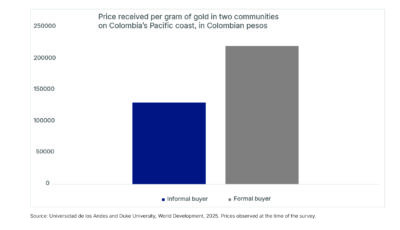
These tools are necessary and they work best alongside something more. They govern the actors who already stand in the formal channel, while the miner still chooses whether to enter it. Many sell to informal buyers who pay less and cash, ask for little paperwork and sit closer to the mine. A registry records the gold that enters the formal channel. By itself, it brings little more of it in. The formal route has to become the most attractive one and that depends on what happens between the mine and the refiner.
Three conditions and where Colombia stands
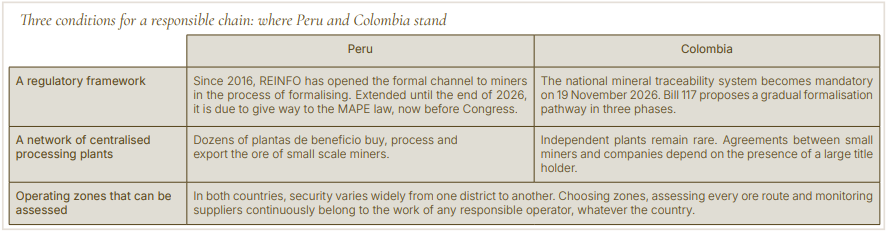
Our experience in Peru through our subsidiary Soleil Metals suggests that a responsible small scale gold chain rests on three structural conditions: a regulatory framework, a manageable exposure to organized crime and a network of centralized processing plants (CPPs) able to buy, process and trace small scale ore. Every country meets them even imperfectly, Peru included, where the model coexists with a large informal economy. Colombia is building the first, can meet the second and still lacks the third.
A regulatory framework in progress. A public registry of miners in formalization is a necessary foundation, even with its limits. In Peru, REINFO opened the formal channel to miners still formalizing, while some registered operators rented their status to illegal miners. The registry is itself under review: extended until the end of 2026, it is due to give way to a new law on small scale and artisanal mining, still under debate in Congress. Colombia is assembling its own foundation, with its national traceability system and a formalization pathway in three phases. The detail of the bill will matter, in particular the treatment of miners still in transition.
An exposure to crime that can be mapped. According to UNODC and the Ministry of Mines and Energy, illegal armed groups are present in 85.6% of the Colombian municipalities where alluvial gold is mined and that reality must be stated plainly. Exposure varies strongly from one district to another, however, including within the departments most affected. A careful choice of zones, combined with an assessment of every route from mine to plant and continuous monitoring of suppliers, keeps this risk within bounds.
A missing network of CPPs. This is the real gap and it concerns hard rock mining above all. A miner who extracts ore, rather than free gold from a river bed, depends on someone else to process it, since that step needs capital, industrial equipment and engineers. Without a plant within reach, he keeps using mercury and sells to whoever comes to the mine. Since November 2025, a public programme also buys gold directly from small producers. It serves the miner who already holds free gold, while the hard rock miner still needs his ore processed first. In Colombia, plants able to buy ore at scale under compliant, mercury free conditions remain rare, held back by a legal framework built around title holders and the security exposure of a fixed installation. For hard rock miners in Antioquia, Bolívar, Caldas, Cauca or Nariño, the formal market for ore therefore remains narrow.
Two pathways in one plant
Peru counts dozens of these plants, known locally as plantas de beneficio. They buy raw ore from small scale miners, extract the gold with industrial methods and sell doré to refiners. Their performance varies widely, while the discipline applied to it belongs to each operator. Our own operations offer one illustration of what that discipline can look like. At Soleil Metals, our two plants, Yacarí and Victoria, work along two parallel pathways. The first produces the metal and the second proves that it is responsible.
The industrial pathway. The plants gather ore from some 450 small scale suppliers in one controlled place, process it with mercury free methods and recover more than 90% of the gold, against 30 to 40% with mercury amalgamation. The doré bars produced go to LBMA Good Delivery refiners, with around one tonne of gold equivalent expected to be produced in 2026.
The compliance pathway. This second pathway applies banking grade compliance to every mining supplier and every lot, in four steps. No ore enters the chain before we fully know the supplier. A banking KYC, adapted to mining, requires a significant list of documents from each of them, covering areas such as legal registration, mining title, beneficial owners, tax position and sanctions screening and an initial improvement plan. We verify the mine, through a field visit by a mining engineer, a geologist, a topographer and a technician. We trace every lot: each one is weighed, referenced and stored separately, its xTrace fingerprint is matched to the miner, its tonnage to the capacity of the mine and a mercury reading flags any concentration inconsistent with the declared geology. We pay and document like a bank, only by bank transfer to the supplier’s own account, with records kept for audit.
Together, the two pathways produce four outcomes: an origin documented against money laundering, mercury kept out of the chain, safer working conditions for miners and a formalization that pays.
Three lessons for operators in Colombia
Structural conditions open the way, but an operator still has to build the value chain. Our Peruvian operations offer three lessons that seem transferable to Colombia.
1. Trust comes before volume. Small miners have historical reasons to distrust formal operators: low prices, contested assays, advances that turn into dependence… A miner sells his ore and keeps selling it, when the price follows a public reference, when he can inspect the assay and when payment arrives quickly. Many first come also for the technical visit, where our mining engineers advise them on topics like ventilation, protective equipment and safety.
2. Verification happens before crushing and others check it. Once ore is mixed, its origin disappears, so every control has to take place at the gate. Independent accreditation and audits then give final buyers a reason to believe the result.
3. Compliance is an investment. Operators who treat traceability as a constraint apply the minimum. Those who treat it as a structural requirement gain access to LBMA refiners, to institutional buyers and to the confidence of regulators.
A window for Colombia
The context favors this transition. International buyers are tightening their sourcing policies, refiners demand documented chains and central banks in the region have committed to principles for responsible domestic gold purchases. Colombia’s own rules now point in the same direction.
For these reasons, untraceable gold will become harder to sell. Colombia has already done one hard part, by writing the rules and winning a measure of political consensus around formalization. What Peru taught us is that the middle of the gold value chain takes just as long to build.
Quarterly digest
Four times a year, nothing more.
A short letter summarising what we have published, what we have signed, and what is forthcoming. No marketing.