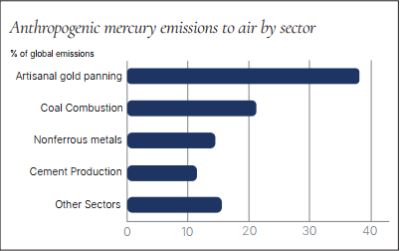
The issue of mercury in the gold value chain is a matter of broad consensus. The Minamata Convention specifically targets it, regulators seek to contain it, and no stakeholder in the sector defends it. Yet, artisanal and small-scale gold mining remains the world’s primary source of mercury dispersion, accounting for approximately 37% of anthropogenic mercury emissions, ahead of coal combustion[1]. To reduce this dependence, a part of the sector is formalizing and entrusting ore processing to industrial facilities, which replace mercury amalgamation with closed-circuit cyanidation—the reference process for global gold production.
A shift in model
This transition to industrial cyanidation requires a structural shift in model. The process demands equipment, containment, and effluent management that only an industrial facility can provide. It therefore requires capital investment and creates an intermediate layer between the miner and the refiner to concentrate and treat the ore. Industrialization presents an additional economic advantage: cyanidation recovers a significantly higher share of gold than amalgamation, increasing the value extracted from the exact same ore. On an environmental level, this change is presented as progress.
This alternative nevertheless raises an objection: it would amount to substituting one problematic substance for another. Cyanide is indeed a hazardous product, which requires a comparison across three dimensions: what each reagent becomes in the environment, the people it reaches, and the duration of its risk. To be valid, this comparison must evaluate comparable scenarios: ASM mercury used in the open air versus industrial cyanide operated in a closed circuit, where effluents are treated and tailings are managed. The comparison makes sense only within this framework.
The fate of each reagent
Let’s begin with mercury. As a stable chemical element, it persists indefinitely in the environment. Mining grinds it into fine droplets, known as “mercury flour,” which water disperses into tailings and transports hundreds of kilometers down rivers[2]. Heating the amalgam to recover the gold also releases mercury as vapor. Wherever it settles, bacteria transform it into methylmercury—a highly toxic form that bioaccumulates up the food chain and concentrates at every stage. Today’s mercury emissions thus remain present for decades, far from their point of origin.
Cyanide, on the other hand, is a molecule: it decomposes. Part of it degrades through natural pathways—such as volatilization, sunlight photolysis, and microbial biodegradation—while another part binds to metals into more stable complexes that can remobilize if conditions change[3]. Therefore, responsible management goes beyond natural degradation: it destroys residual cyanide in the effluents via oxidation processes before discharge, monitors concentration levels, and confines tailings in a sealed, monitored facility[4]. Properly managed, cyanide risk decreases to a negligible level.
Exposed populations
Beyond their fate, the two reagents are also distinguished by the people they impact. Mercury from artisanal gold mining reaches populations via two pathways. By air: miners and local villagers breathe in vapors at concentrations that far exceed WHO thresholds. By diet: transformed into methylmercury, it contaminates fish and irrigated crops like rice, ultimately reaching pregnant women and children. Exposure is chronic and strikes people completely unrelated to the mining activity.
Cyanide presents a very different profile. Its risk is strictly time-bound. It primarily concerns plant operators working within a controlled, equipped, and monitored environment. While the risk of transport accidents, storage leaks, or tailings dam failures is not zero and could theoretically impact waterways over significant distances, any potential damage is severe but temporary[5]. Cyanide degrades within days or weeks and does not enter the food chain. Exposed populations remain identifiable, exposure pathways are known, and risks are mitigated through safety and containment protocols.
A risk reduction under conditions
An environmental risk depends on two components: toxicity and environmental fate after release. Since both reagents are highly toxic, what separates them is their fate: dispersed mercury diffuses far and persists, while confined cyanide is treated on-site and its risk declines.
However, scaling this alternative requires overcoming several non-chemical obstacles. The first is economic: beyond initial investments, a closed-circuit plant must achieve sufficient processing scale and rely on a stable supply logistics network—two elements lacking in many gold-producing regions. The second is regulatory: cyanidation is restricted to industrial operators whose access to cyanide is tightly regulated, and the ore they process must be purchased legally, which requires formalization frameworks for miners that remain incomplete in most countries. The third concerns miner trust. Accustomed to selling for cash to informal traders, miners often fear that a factory will undervalue their ore’s gold content or delay payments. They will only commit their production long-term if the plant guarantees transparent estimation, fair pricing, and rapid payment.
The fourth obstacle concerns plant governance. By aggregating ore from dozens or hundreds of miners, a plant becomes the central node of the ASM chain. Without strict oversight, it could inadvertently process mercury-extracted ore or be used to launder illicit gold. Eliminating mercury therefore requires robust compliance and traceability systems to verify how the ore was extracted, batch by batch.
This verification hinges entirely on the receiving stage. As long as the ore arrives in distinct batches, its origin remains traceable from the mine to the factory gates. Once crushed and milled, the ore becomes fungible and indistinguishable from any other batch, destroying this connection permanently. Proof of mercury-free extraction must therefore be established prior to crushing.
The model implemented by Soleil Metals, the Peruvian subsidiary of the OCIM group, at its Victoria and Yacari plants provides an illustration. During the upstream phase, each supplier’s onboarding file and site visit document their mining practices, including any potential use of mercury. Upon arrival at reception, each batch is weighed, numbered, and stored separately by producer. Then, a sample undergoes mercury testing: since mercury occurs naturally in certain rocks, any concentration incompatible with the geology of the declared source is flagged and reviewed, because cyanidation of amalgamated ore would remobilize this mercury. The chemical fingerprint of the ore, taken by an origin verification technology called xTrace and compared to the producer’s registered profile, confirms that the batch comes from the declared mine. Natural mercury recovered during processing is captured and stored. Finally, at the output stage, each doré bar receives a fingerprint, allowing a refiner to personally verify, by comparison, that the metal received is the exact same that left the plant.
This set of procedures provides downstream actors with a verifiable assurance that the ore was mined without mercury. The refiner receives metal accompanied by its origin file—compiled by the actor closest to the miner—and a fingerprint they can check. They can thus defend a supply chain whose upstream operations have renounced mercury to their own committees. The necessary tools exist: the LBMA’s ASM Toolkit, formalization registries, and origin verification technologies. What remains to be built is the multiplication of operators who apply them consistently and at a large scale. Phasing out mercury from ASM gold is therefore a complex, multifaceted challenge that is simultaneously chemical, economic, regulatory, and governance-driven.
[1]UNEP, Global Mercury Assessment, 2018].
[2]L. J. Esdaile and J. M. Chalker, “The Mercury Problem in Artisanal and Small-Scale Gold Mining”, Chemistry – A European Journal, 24, 2018, p. 6905-6916.)
[3]Esdaile and Chalker, 2018; K. Drace, A. M. Kiefer and M. M. Veiga, “Cyanidation of Mercury-Contaminated Tailings”, Current Environmental Health Reports, 3(4), 2016.
[4]International Cyanide Management Institute, International Cyanide Management Code.
[5]D. B. Donato et al., “Heap Leach Cyanide Irrigation and Risk to Wildlife”, Ecotoxicology and Environmental Safety, 2017.